
Predator
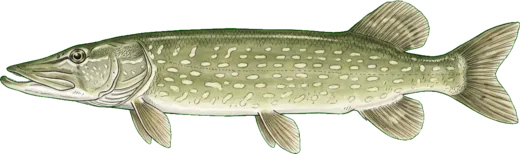
Pike
Esox lucius
How to identify
Long, green-and-cream-marbled predator with a duck-billed snout, a mouth full of teeth, and the dorsal and anal fins set far back near the tail.
Easily confused with
Zander (spiny dorsal, glassy eyes, stripes).
Habitat
Lakes, rivers, canals, drains and big lochs and loughs; ambush predator near weed, reeds and drop-offs.
Where in the UK & Ireland
Throughout England, Wales, Scotland and Ireland; Irish loughs are world famous.
Season & close season
Best autumn and winter; many fisheries do not allow pike fishing in summer due to stress on the fish in warm water.
Best baits
Deadbaits (smelt, sardine, mackerel, roach), lures (spinners, spoons, soft plastics, jerkbaits), livebaits only where allowed.
Rigs & methods
Float-ledgered or ledgered deadbaits, lure fishing, fly fishing for pike.
Tackle
2.75-3 lb test curve rod, 15-20 lb line, a wire trace of at least 18 inches, long-nosed forceps and an unhooking mat.
Watercraft
Look for features: drop-offs, reed lines and areas where prey fish shoal. Fish early and late in clear water.
Conservation & the law
Always use a wire trace and carry unhooking tools. Many waters ban live baits or the use of fish from other waters.
Rod Race tip
A deadbait on a canal in winter or a spinner along a reed line will usually find one.
How the Rod Race works →Where to catch pike
Reported at reported
LakeAbberton Reservoir, Essex
Essex, England
LakeArdleigh Reservoir, Essex
Essex, England
LakeBassenthwaite Lake, Cumbria
Cumbria, England
LakeBlessington Lakes, Wicklow
Wicklow, Ireland
 River
Bristol Avon, Keynsham
Keynsham, England
 Canal
Broadwater
Moira, Northern Ireland
 Lake
Bury Hill Fisheries, Surrey
Surrey, England
LakeCheddar Reservoir, Somerset
Somerset, England
 Lake
Chew Valley Lake, Somerset
Somerset, England
LakeClay Lake
Keady, Northern Ireland
RiverColebrooke River
Lisnaskea, Northern Ireland
LakeConiston Water, Cumbria
Cumbria, England
LakeCotswold Water Park, Gloucestershire
Gloucestershire, England
LakeCraigavon City Park Lake - North
Craigavon, Northern Ireland
LakeCraigavon City Park Lake - South
Craigavon, Northern Ireland
LakeEnagh Lough
Armagh, Northern Ireland
 River
Hampshire Avon, Ringwood
Ringwood, England
LakeHanningfield Reservoir, Essex
Essex, England
LakeHollowell Reservoir, Northamptonshire
Northamptonshire, England
LakeHorseshoe Lake, Lechlade
Lechlade, England
LakeKillyfole Lough (Mill Lough)
Clones, Northern Ireland
LakeLadybower Reservoir, Derbyshire
Derbyshire, England
LakeLinear Fisheries, Oxon
Oxon, England
LakeLlandegfedd Reservoir, Monmouthshire
Monmouthshire, Wales
Rivers & canals where it's likely likely (4,161 waters)
River Thames
near Greenwich, England · 378 km
River Shannon
near Drumshanbo, Ireland · 357 km
River Severn
near Much Wenlock, England · 307 km
River Trent
near Gainsborough, England · 287 km
River Avon
near Tidworth, England · 262 km
River Usk
near Usk, Wales · 220 km
Leeds and Liverpool Canal
near Brierfield, England · 207 km
River Stour
near Gillingham, England · 196 km
River Great Ouse
near Stony Stratford, England · 192 km
River Suir
near Cahir, Ireland · 182 km
River Avon
near Pershore, England · 176 km
River Barrow
near Monasterevin, Ireland · 170 km
River Spey
near Kingussie, Scotland · 168 km
River Nene
near Wellingborough, England · 168 km
River Wye
near Ross-on-Wye, England · 167 km
River Blackwater
near Millstreet, Ireland · 165 km
River Erne
near Cavan, Ireland · 163 km
River Tweed
near Innerleithen, Scotland · 161 km
River Tame
near Lichfield, England · 160 km
River Tees
near Darlington, England · 152 km
River Dee
near Ballater, Scotland · 148 km
River Welland
near Stamford, England · 142 km
River Aire
near Farsley, England · 140 km
River Clyde
near Lanark, Scotland · 137 km
Also likely at many lakes, rivers, canals — see them on the map.
Recent catches
None logged yet.